

This Simple Exercise Habit May Keep Your Brain Younger
Adults who exercised regularly for a year had brains that appeared nearly a year younger on MRI scans.
Protecting brain health is a lifelong effort, and new findings from the AdventHealth Research Institute suggest that regular exercise could play a meaningful role. Researchers report that maintaining a consistent aerobic workout routine may help the brain remain biologically younger. This could translate into sharper thinking, stronger memory, and better overall well-being.
In the study, adults who completed a structured year-long aerobic exercise program had brains that appeared almost one year “younger” than those of participants who did not increase their physical activity.
How Scientists Measured Brain Age
The findings, published in the Journal of Sport and Health Science, focused on whether aerobic exercise could slow or possibly reverse “brain age.” Brain age is estimated using magnetic resonance imaging (MRI), which compares how old a brain appears to a person’s actual age. A higher brain-predicted age difference (brain-PAD), indicates that the brain looks older than expected. Previous research has connected higher brain-PAD scores with weaker physical and cognitive performance and a greater risk of mortality.
“We found that a simple, guideline-based exercise program can make the brain look measurably younger over just 12 months,” said Dr. Lu Wan, lead author and data scientist at the AdventHealth Research Institute. “Many people worry about how to protect their brain health as they age. Studies like this offer hopeful guidance grounded in everyday habits. These absolute changes were modest, but even a one-year shift in brain age could matter over the course of decades.”
Inside the 12 Month Clinical Trial
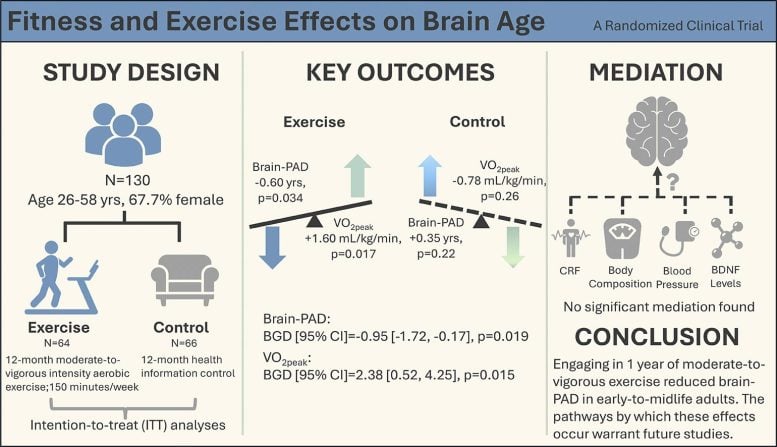
The clinical trial enrolled 130 healthy adults aged 26 to 58. Participants were randomly assigned to either a moderate-to-vigorous aerobic exercise group or a usual-care control group. Those assigned to exercise completed two supervised 60-minute sessions each week in a laboratory setting and added home workouts to reach about 150 minutes of aerobic activity per week. This level matches recommendations from the American College of Sports Medicine.
Researchers performed brain MRI scans and measured cardiorespiratory fitness using peak oxygen uptake (VO2peak) at the beginning and end of the 12-month study.
Exercise Reduced Brain Age
After one year, the exercise group showed a measurable decrease in brain age, while the control group experienced a slight increase. On average, brain-PAD in the exercise group dropped by about 0.6 years, meaning their brains appeared younger at follow-up. In contrast, the control group’s brains appeared about 0.35 years older, though that change was not statistically significant. Overall, the difference between the two groups approached one full year in favor of the exercise group.
“Even though the difference is less than a year, prior studies suggest that each additional ‘year’ of brain age is associated with meaningful differences in later-life health,” said Dr. Kirk I. Erickson, senior author of the study and a neuroscientist and director at AdventHealth Research Institute and the University of Pittsburgh. “From a lifespan perspective, nudging the brain in a younger direction in midlife could be very important.”
Why the Brain Benefits Remain Unclear
To better understand how exercise affected brain age, the team examined several potential factors, including improvements in fitness, changes in body composition, blood pressure, and brain-derived neurotrophic factor (BDNF) levels, a protein involved in brain plasticity. Although fitness improved, none of these factors accounted for the reduction in brain-PAD observed in the study.
“That was a surprise,” Wan noted. “We expected improvements in fitness or blood pressure to account for the effect, but they didn’t. Exercise may be acting through additional mechanisms we haven’t captured yet, such as subtle changes in brain structure, inflammation, vascular health, or other molecular factors.”
Targeting Midlife for Long-Term Brain Health
Many previous studies on exercise and brain health have focused on older adults, when age-related changes are already more advanced. This research instead examined adults in early to mid adulthood, when brain changes are less noticeable but preventive strategies may have a greater long-term impact.
“Intervening in the 30s, 40s, and 50s gives us a head start,” Erickson said. “If we can slow brain aging before major problems appear, we may be able to delay or reduce the risk of later-life cognitive decline and dementia.”
What the Findings Mean
The researchers caution that participants were healthy and generally well educated, and the reductions in brain age were modest. Larger studies with longer follow-up are needed to determine whether lowering brain-PAD through exercise reduces the risk of stroke, dementia, or other age-related brain diseases.
“People often ask, ‘Is there anything I can do now to protect my brain later?’” Erickson said. “Our findings support the idea that following current exercise guidelines — 150 minutes per week of moderate-to-vigorous aerobic activity — may help keep the brain biologically younger, even in midlife.”
Reference: “Fitness and exercise effects on brain age: A randomized clinical trial” by Lu Wan, Cristina Molina-Hidalgo, Mary E. Crisafio, George Grove, Regina L. Leckie, Thomas W. Kamarck, Chaeryon Kang, Mia DeCataldo, Anna L. Marsland, Matthew F. Muldoon, Mark R. Scudder, Javier Rasero, Peter J. Gianaros and Kirk I. Erickson, 13 August 2025, Journal of Sport and Health Science.
DOI: 10.1016/j.jshs.2025.101079
Dr. Lu Wan has served as a Data Scientist at AdventHealth in Orlando, Florida, since June 2024. She previously worked as a Data Engineer at the University of Pittsburgh and as a Biomedical Engineer at Spaulding Rehabilitation Hospital. She earned her PhD after completing graduate research training at the University of Florida. Her work focuses on brain aging, physical activity, and cognitive health across adulthood. She is affiliated with the AdventHealth Neuroscience Institute, a nationally recognized center for brain research and care.
Dr. Kirk I. Erickson is the Director of Translational Neuroscience and the Mardian J. Blair Endowed Chair of Neuroscience at the AdventHealth Research Institute. He received his Ph.D. from the University of Illinois at Urbana-Champaign and completed postdoctoral training at the Beckman Institute. Previously a Professor at the University of Pittsburgh, he studies how physical activity influences brain health across the lifespan. He has published more than 350 scientific papers, led major NIH funded trials, and served on the U.S. Physical Activity Guidelines Advisory Committee.
The study was funded by the National Institutes of Health and the National Heart, Lung, and Blood Institute (Grant P01 HL040962) awarded to Peter J. Gianaros and Kirk I. Erickson.
Never miss a breakthrough: Join the SciTechDaily newsletter.
Follow us on Google and Google News.
Source link
